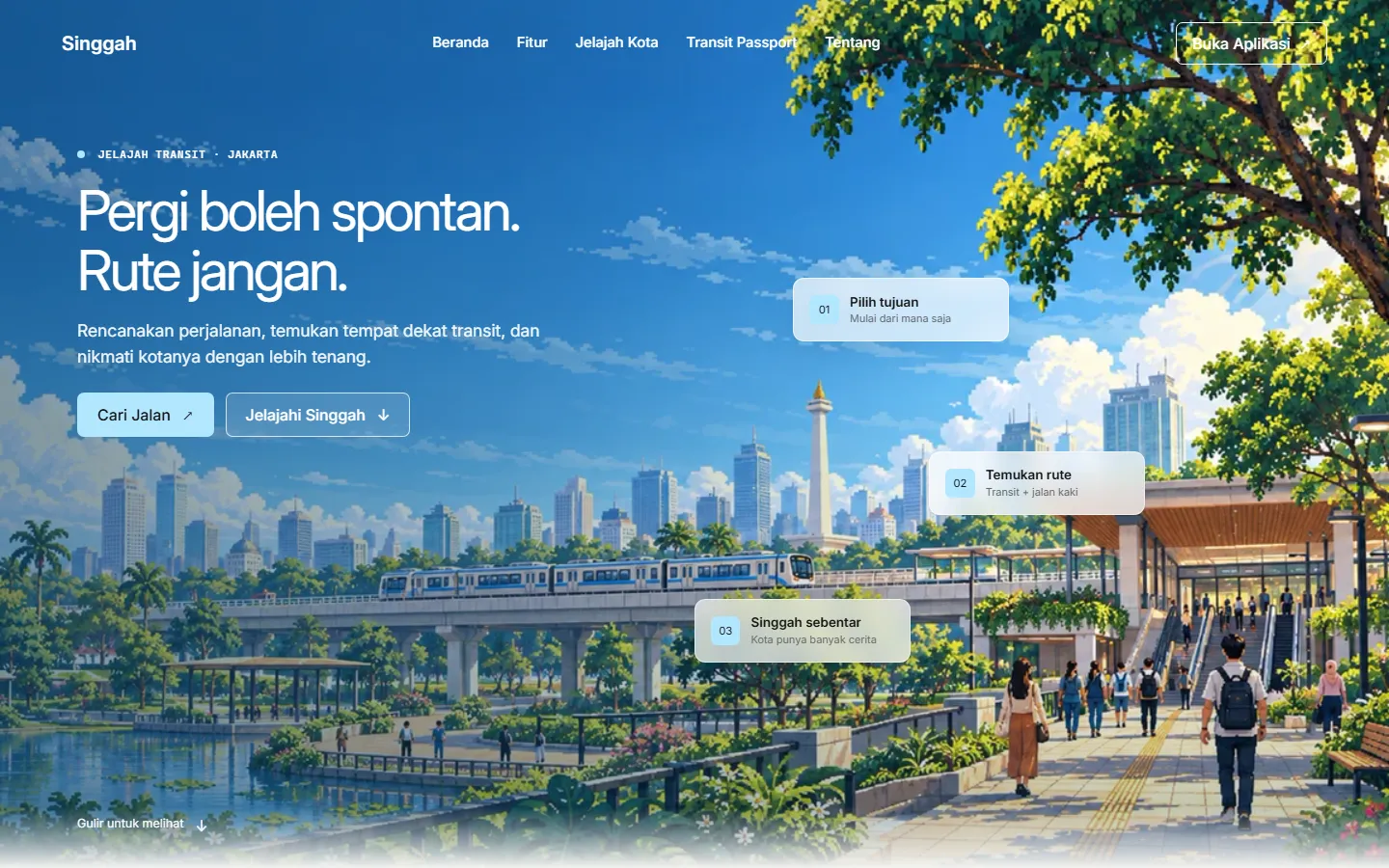

Singgah
Transit-First City Exploration Companion
Overview
Singgah is a personal product built around a simple idea: exploring the city should feel calm when public transport is the default. It is a pnpm/Turborepo monorepo — a SvelteKit + Svelte 5 client, a Go API (chi router) on PostgreSQL/PostGIS, an OpenAPI contract that generates the TypeScript client, and a custom schematic-map builder tool. The frontend only consumes canonical API models, never provider payloads.
Problem
Exploring a city by public transport means stitching together routes, modes, and stops from scattered sources — and most map apps optimize for driving or fastest route, not for calmly understanding a transit network.
Solution
A transit-first web app that puts stations, routes, and journeys at the center — schematic map rendering, a journey timeline, map search, and a transit passport — all served through one API contract shared by the Go backend and the SvelteKit client.
Responsibilities
- Designed the monorepo layout — pnpm workspaces + Turborepo for the client, go.work for services
- Authored the OpenAPI contract and generated TypeScript client
- Built the Go API — chi router, sqlc-generated queries, goose migrations
- Built the SvelteKit interface — map mode switcher, journey timeline, map search
- Set up the PostGIS schema and local Docker Compose environment
- Maintained a docs-as-blueprint workflow — product and engineering source of truth in docs/
Key Features
- Schematic transit map rendering via a custom map-builder tool
- Journey timeline and station/route search
- Transit passport — private, anonymous-session progress tracking
- Canonical API contract — OpenAPI generates the client
- PostGIS-backed spatial data
- Strict quality gates — format, lint, typecheck, and tests in CI
Technology
- SvelteKit + Svelte 5
- TypeScript (strict)
- Tailwind CSS
- Vitest
- Go — net/http + chi
- PostgreSQL + PostGIS
- pgx + sqlc
- OpenAPI contract-first
- pnpm workspaces + Turborepo
- Docker Compose
Technical Decisions
- Contract-first API: The OpenAPI spec is the source of truth — the generated TypeScript client keeps frontend and backend honest.
- Canonical models only: The frontend never sees provider payloads; the Go backend owns all authoritative logic and normalization.
- Per-language tooling: pnpm workspaces + Turborepo for the client, go.work for services — each ecosystem keeps its idiomatic workflow.
Impact
- Working end-to-end foundation — API health/readiness, generated client, migrated PostGIS schema, and full CI quality gates